
Outline


Get In Touch
Get In Touch
Key Takeaways
AI is replacing tasks — not developers
AI can handle repetitive, procedural work like code generation, testing, and maintenance workflows. But it still relies on developers to design, guide, and validate those systems.The real value is in how AI is implemented
AI isn’t plug-and-play. The effectiveness of an agent depends on how well it’s trained on your specific processes, standards, and workflows—not just the model itself.Automation works best for structured, repeatable tasks
The WordPress maintenance example shows that AI excels at predictable, step-by-step processes—cutting execution time significantly while maintaining consistency.Failures are part of the system design—not a flaw
The demo failure highlights an important truth: AI systems will miss edge cases. Catching those failures in controlled environments (with human oversight) is exactly how reliable systems are built.Developers shift from execution to oversight and strategy
As AI handles execution, developers focus more on reviewing outputs, improving systems, handling exceptions, and making judgment calls—elevating their role rather than replacing it.
Code Generation, Code Assistance, and What AI Actually Handles Today
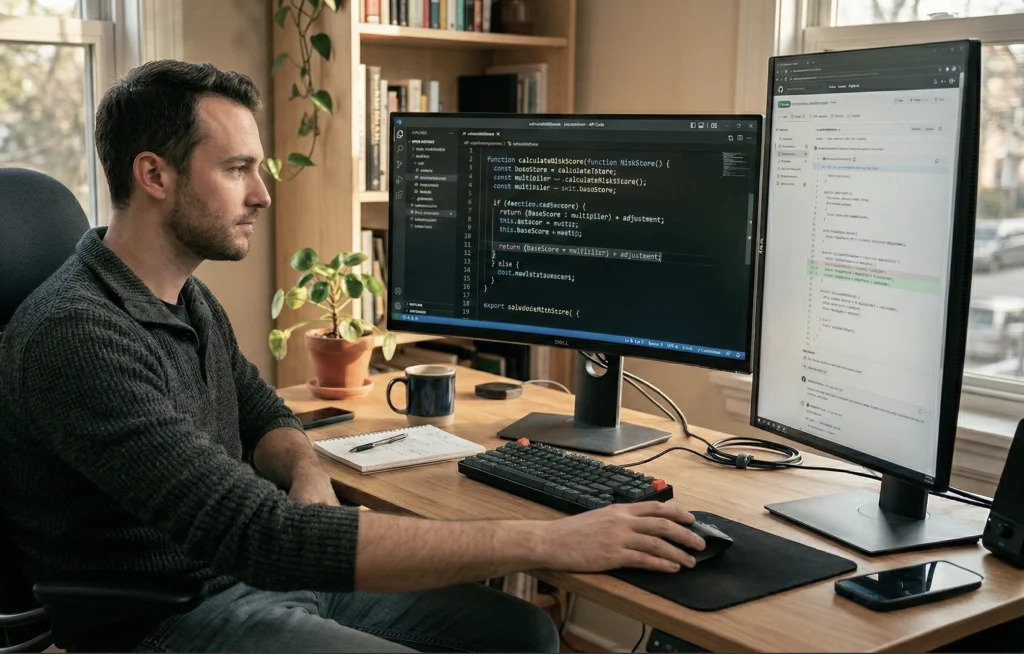
Before getting into our specific experiment, it’s worth being clear about what artificial intelligence is already handling in development workflows, because the conversation about replacement often ignores how much has already changed.
AI Coding Agents like Codex and Claude Code can suggest entire functions, complete boilerplate, and generate code from plain-language descriptions. Code assistance features built into modern IDEs like Windsurf surface relevant documentation, flag potential errors, and propose fixes in real time. AI-powered testing tools can automatically write test cases, identify edge cases, and flag regressions. For developers who work with these tools daily, a significant portion of the lower-level, mechanical work is already handled by artificial intelligence.
None of this has replaced web developers. What it has done is shift where developer time and skill are applied. The developers getting the most from these tools aren’t the ones handing everything to AI, they’re the ones who understand the output well enough to know when it’s right, when it’s wrong, and when it needs a human decision the model isn’t equipped to make.
That distinction matters, and it’s the lens through which our experiment makes most sense.
Code generation and code assistance have already changed what day-to-day development looks like. The question was never ‘will AI get involved’ — it was always ‘how do you govern it properly.’
How We Built an Agentic AI Workflow for WordPress Maintenance
The task we chose to automate was WordPress maintenance, specifically, the monthly update process covering core, plugins, and themes across client sites.
A WordPress update sounds straightforward. In practice, when done properly, it involves a defined sequence: verifying backups, deploying to staging, running updates in the correct order to avoid dependency conflicts, running visual regression checks, deploying the pipeline to production, and logging the outcome. Typically, this process takes around 45 minutes per site. The work isn’t intellectually demanding; it’s procedural, sequential, and unforgiving if a step is missed. Automating repetitive tasks like these is exactly where agentic AI can deliver real, measurable value.
The system we built uses a multi-agent architecture, rather than a single AI managing the entire workflow. We designed a team of agents with specific roles: one to understand the environment, one to plan the sequence, one to execute, and a WordPress-specific agent trained on our internal procedures. That last part is critical. A generic artificial intelligence model doesn’t know how Fahrenheit Marketing handles WordPress maintenance. We taught it, using our own documentation, processes, and standards. The output quality depends directly on the quality of that training.
Automating repetitive tasks with AI isn’t about pointing a model at a process and hoping it works. It’s about teaching the agent your specific way of doing things — and that requires your team’s expertise to be in place first.
The Live Demo That Failed — And What We Learned from It

I demoed the workflow live at our first internal Applied AI Roundtable. The agent received the prompt, identified the correct client environment, completed the update procedure, and finished the core work in just under 3 minutes.
Then it failed to post the results to our project management tool. It had access. It knew it was supposed to report back. It skipped the step anyway, in front of everyone.
I wasn’t embarrassed. If anything, I was in good company. The AI industry has a name for this: demo demons. It’s the near-universal tendency for live AI demonstrations to surface the one edge case you didn’t anticipate, at exactly the wrong moment. Even the major AI labs aren’t immune. OpenAI, Google, and Anthropic have all had high-profile demo moments where their own models misbehaved on stage. The difference is what you do with it.
A failure in a controlled environment is exactly where you want to find these gaps, not after you’ve removed the human checkpoints. What the demo made clear is that agentic AI web development workflows are not plug-and-play. They require the same rigour you’d apply to any system going into production: build it, test it, find the edge cases, and harden the process before it touches anything client-facing.
The practical upside is still significant. End-to-end, including the steps the agent doesn’t yet fully handle, I don’t see the total process exceeding 15 to 20 minutes compared to 45 minutes done manually. Across every site we maintain, that efficiency gain compounds quickly.
Will AI Replace Web Developers? Here's the Real Answer
Artificial intelligence will replace certain tasks. It will not replace the developers who understand how to build, deploy, and govern the systems that handle those tasks.
Code generation can write a function. Code assistance can flag an error. An agentic workflow can run a WordPress update. None of these things requires a developer to execute them once the system is built. All of them required significant developer expertise to design, train, test, and validate before they could run reliably.
What changes is where developer time is spent. In our WordPress maintenance workflow, the developer is no longer spending 45 minutes executing a known procedure. They’re spending that time reviewing output, improving the process, handling the exceptions the agent wasn’t built for, and making the judgment calls that fall outside the defined parameters. That’s a better use of skill, not a threat to it.
The more useful question isn’t whether artificial intelligence will replace web developers. It’s whether developers who use AI will replace those who don’t. The answer to that is yes, and the pace is faster than most people expect.
AI will replace certain tasks. It won’t replace the developers who know how to build, train, and govern the systems that handle those tasks.
Why We Keep Humans in the Loop — And When That Changes
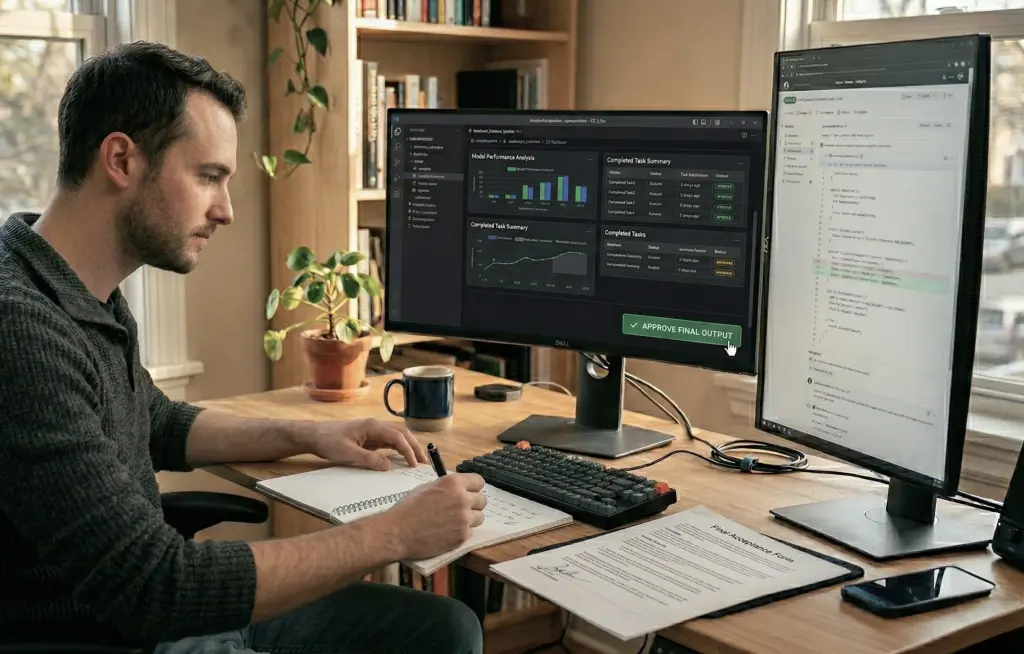
One thing we’ve been deliberate about is the role of human validation in every AI-assisted workflow we deploy. The principle is straightforward: don’t remove a human checkpoint until you’ve built the track record that justifies it.
For the WordPress maintenance workflow, that currently means:
- The agent completes the update and runs a visual comparison, checking before and after screenshots for regressions
- A developer reviews the output and manually browses the site before sign-off
- We’re building toward a second AI layer, a code review step where a second agent audits the first agent’s work before it reaches the developer
The goal is: AI handles execution, AI checks AI, and a human owns final accountability. That’s not a reduction of the developer’s role, it’s a refinement of it. The demo failure was caught immediately because the human checkpoint was in place. That’s the design working as intended.
Will that change over time? Yes, for specific, well-defined tasks where the success rate is consistently high enough to justify it. But we’ll earn that confidence through evidence, not assumption.
Evaluating a Web Development Agency in the Age of AI: What to Ask
If you’re a business owner or marketing manager evaluating a development agency, the question isn’t whether they’re using artificial intelligence. Most agencies are, in some form, for code generation, code assistance, testing, or automating repetitive tasks across client workflows.
The question worth asking is: What does your governance and validation process look like?
An agency with a clear answer, documented validation steps, defined human checkpoints, and a structured approach to agentic AI web development is one worth working with. An agency using AI to move faster without a governance layer is a risk, and the problems tend to emerge after work is delivered rather than before.
At Fahrenheit Marketing, artificial intelligence accelerates and improves the consistency of our development processes. It doesn’t replace the human expertise that makes those processes reliable. That balance is what responsible web development looks like in 2026.
This article is part of Fahrenheit Marketing’s Applied AI Roundtable series — a weekly all-company meeting where team members across every discipline present how they’re applying AI in their day-to-day work. Each session is an opportunity to share what’s working, what isn’t, and what the rest of the team can take and use immediately.