Outline


Get In Touch
Get In Touch
Key Takeaways
- Tools vs. Architecture: Avoid confusing tactical AI tools (such as ChatGPT) with a strategic AI architecture. Tools create fragmented, risky, "shiny object" workflows. An architecture builds a scalable, proprietary, and defensible growth engine.
- Pillar 1: Unified Data Foundation: The real power for enterprises is their siloed first-party data (CRM, CDP, support tickets). An AI architecture unifies this data to answer strategic questions that public AI has never been able to.
- Pillar 2: Integrated MarTech Engine: AI should not be another platform. It should be the intelligence layer within your existing stack (E.g., Salesforce, Adobe), automating personalization and next-best-actions at a 1:1 level.
- Pillar 3: Governance & Amplification Framework: For large brands, governance is non-negotiable. This framework provides brand/legal guardrails and "amplifies" your Subject Matter Experts (SMEs), using AI to scale their expertise, not just generate generic content.
- The New Playbook: The shift is from using AI to perform tasks (e.g., "write a blog post") to using an AI system to drive outcomes (e.g., "analyze our CRM data, find a high-LTV segment, and assist our SME in creating a personalized campaign").
The C-suite is awash in AI hype. Every vendor promises transformation. Every keynote overflows with buzzwords.
But for enterprise marketing leaders, this creates a frustrating gap between the promise of AI and the reality of implementation.
The reality is that most large brands are stuck in “Phase 1” of AI adoption. They are experimenting with generative AI for “tasks”—writing ad copy, brainstorming blog ideas, or creating images.
These are tactical efficiencies, but they are not a transformation. They don’t create a competitive moat, nor do they drive scalable growth.
Why? Because they confuse AI tools with AI architecture.
Using ChatGPT to write a blog post is like using a power drill to build a single birdhouse. Creating AI for enterprise growth is like designing the power grid, foundation, and automated assembly line to build a 50-story skyscraper.
For large brands, the path to real, defensible AI-powered growth is not about using AI; it’s about building a system. It’s time to move beyond the hype and start drawing the blueprints.
The Enterprise Fallacy: Tools vs. Growth Engine
The “AI tool” approach is a trap for large brands. It leads to a fragmented, ungoverned, and unscalable ecosystem:
- Data & Brand Risk: Your marketing team in Germany is using one tool, your US sales team another. Your brand voice becomes inconsistent. Sensitive customer data is uploaded to third-party platforms without review.
- No Scalable IP: You are teaching a public model. Your insights and learnings are not captured as a proprietary asset.
- Fragile Workflows: When a new, “better” tool appears, your team must start over, re-learning and re-integrating. This is a constant, expensive cycle of “shiny object syndrome.”
An AI architecture, by contrast, is a foundational, proprietary system that integrates with your core business. It’s an engine, not a gadget.
It focuses on building a system that leverages your most valuable assets: your first-party data and your people’s expertise.
The 3 Pillars of an Enterprise AI Growth System
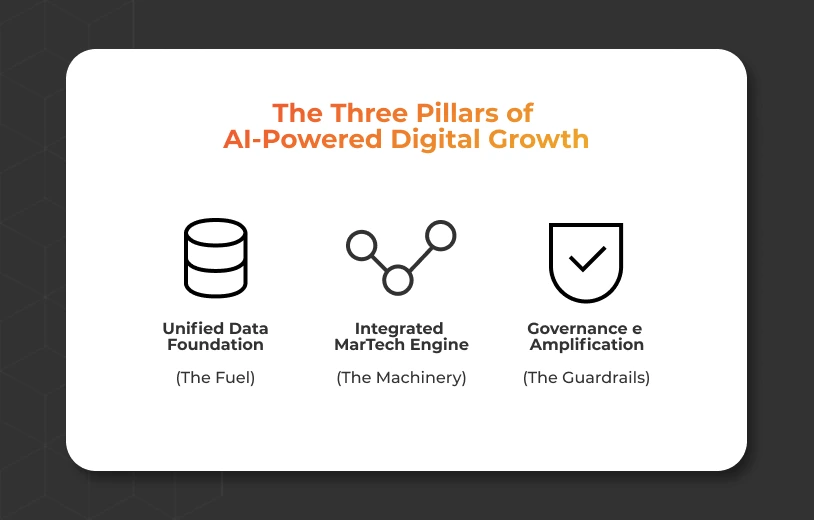
True AI-powered growth requires an integrated system built on three foundational pillars.
Pillar 1: The Unified Data Foundation (The "Fuel")
AI is only as smart as the data it’s trained on. While startups must rely on public, generic data, enterprises are sitting on a goldmine of proprietary first-party data. The single biggest challenge is that this data is almost always in silos.
- CRM Data: Decades of customer relationships, deal sizes, and sales cycles.
- CDP / DMP Data: Billions of data points on user behavior, site interactions, and campaign responses.
- Customer Support Data: Millions of support tickets, chat logs, and call transcripts—a literal vault of customer pain points, feature requests, and buying signals.
Establishing this pillar means unifying these disparate sources. It means creating a secure, AI-accessible “single view of the customer” that can be used to train and fine-tune models.
The Architectural Shift: Instead of asking AI, “What are common pain points for CTOs?” (a public query), you can ask your own AI, “What are the top 3 pain points mentioned in support tickets from our own Fortune 500 CTO customers in the last 90 days?”
The first answer is a commodity. The second is an unassailable competitive advantage.
Pillar 2: The Integrated MarTech Engine (The "Machinery")
Your AI architecture should not be another platform for your team to log into. It should be the intelligence layer that makes your existing, multi-million dollar MarTech stack smarter.
The goal is to infuse AI within the workflows your team already uses.
- In your CRM (e.g., Salesforce): AI predicts lead scores based on nuanced behavioral data, suggests the next best action for a sales rep, and even drafts a personalized follow-up email based on the prospect’s known pain points.
- In your Marketing Automation (e.g., Adobe/Marketo): AI moves beyond simple “if-then” journeys. It creates truly dynamic 1:1 customer journeys, personalizing content, creative, and send times at an individual level based on predictive models.
- In your CMS (e.g., AEM, Sitecore): AI dynamically personalizes web experiences on the fly, surfacing the most relevant case studies, white papers, or product features for each unique visitor.
Activating this pillar involves deep integration, not superficial “plug-ins.” It’s about leveraging APIs and dedicated models to make your core systems work for you, turning data into actionable insights.
Pillar 3: The Governance & Amplification Framework (The "Guardrails")
For a large brand, a “rogue” AI is a legal and PR nightmare. You cannot afford to have AI generate inaccurate product claims, violate regulatory compliance (such as GDPR or HIPAA), or damage your hard-earned brand reputation.
This is where “Phase 1” AI users fail. An enterprise architecture prioritizes governance from day one.
Activating this pillar involves two parts:
1. Governance (The Guardrails):
- Brand Voice & Tone: Creating custom models and prompts trained on your style guides.
- Compliance: Building automated workflows for legal, medical, and regulatory review.
- Fact-Checking: Implementing “human-in-the-loop” systems where AI assists your subject-matter experts (SMEs), but the SME has the final approval.
2. Amplification (The Accelerator):
- This framework turns your SMEs into 10x content producers.
- Instead of AI “writing” a post, the SME provides the core insights, outline, and expertise. The AI then acts as a world-class assistant, structuring the draft, optimizing it for SEO, and breaking the final piece into 20 distinct assets (LinkedIn posts, email snippets, ad copy, video scripts).
- This scales your expertise, not just your word count.
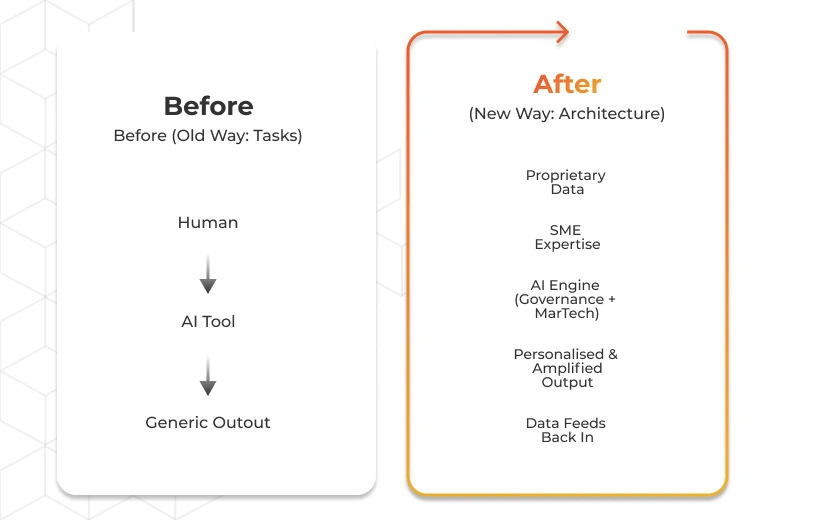
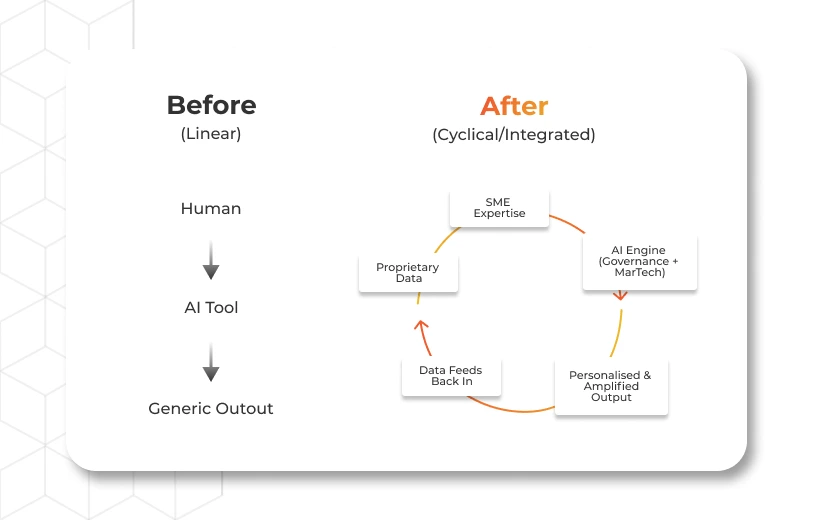
The New Playbook: From AI Tasks to an AI Engine
Let’s see the difference in a real-world example:
The Old Way (AI Tools)
The New Way (AI Architecture)
1. Prompt ChatGPT: “Give me 10 ideas for a B2B marketing campaign.” (Generic)
1. [Data Foundation] AI analyzes CRM & CDP data: “Our highest-LTV customers who purchased in Q4 last year all viewed [Case Study X] and mentioned [Pain Point Y].”
2. Prompt Jasper AI: “Write a blog post about [Pain Point Y].” (Generic, no SME)
2. [Governance Framework] AI drafts a campaign brief for an SME based on this data. The SME provides 5 core insights.
3. Manual Work: Manually build an email journey and ad groups in Marketo/Google.
3. [MarTech Engine] AI assists the SME in creating a core “pillar” asset. Each segment receives tailored messaging based on their specific pain points and behavior patterns as identified in step 1.
Old Way: “Team Time: 40+ hours of manual work per campaign”
New Way: “Team Time: 8 hours of SME strategic input, AI handles execution and scaling”
Result: A generic, low-impact campaign that adds to the noise.
Result: A hyper-relevant, data-driven, and scalable campaign that speaks directly to proven customer needs and is amplified by your best SMEs.
The ROI Indicator
This strategic shift delivers measurable business value: expect to see a 30-50% improvement in campaign efficiency due to automation, leading to higher lead quality as messaging is precisely matched to specific buyer needs. The proprietary nature of the insights drives a stronger competitive advantage and better conversion rates across the funnel.
Conclusion: Stop Buying Hype, Start Building Your Engine
The generative AI tools available today are commodities. Every one of your competitors has access to them.
Your first-party data, your integrated systems, and your SME expertise are not.
The real winners in the AI-powered era will not be the fastest to adopt the latest “tool.” They will be the most deliberate and strategic in building a foundational architecture that leverages their unique, proprietary advantages.
Stop focusing on the hype in the headlines and start focusing on the blueprints. That is how you strategize real, defensible digital growth.
Ready to design your enterprise AI growth system?
This is not a simple “plug-in.” It’s a strategic shift. At Fahrenheit Marketing, we specialize in helping large brands navigate complex digital transformations.
We build the strategies that connect data, technology, and marketing into a single, scalable growth engine.
Schedule your free consultation today to assess your AI architecture readiness.