
Outline


Get In Touch
Get In Touch
Key Takeaways
- The New Gatekeeper: AI Overviews act as a "research assistant" for the entire enterprise buying committee (CTO, CFO, CISO), synthesizing technical, financial, and practical data into one answer.
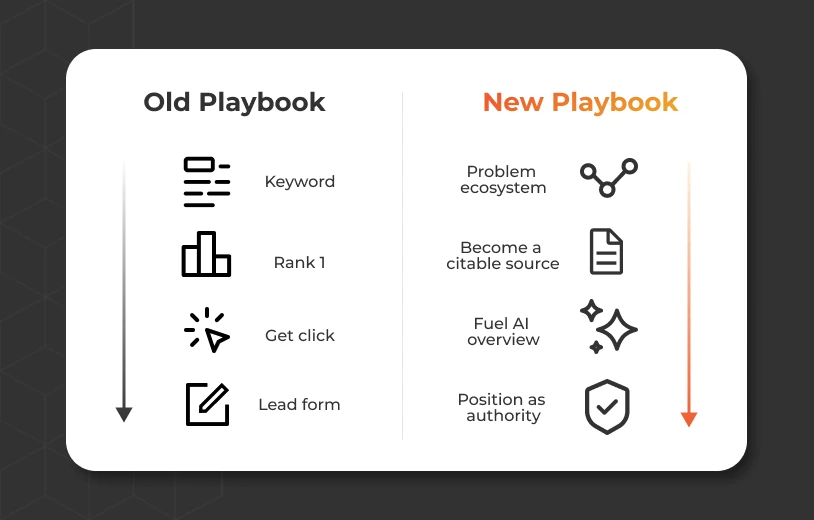
- From Keywords to Problems: Shift your strategy from targeting single keywords to owning the entire "Problem-Solving Ecosystem." Your content must be an interconnected web that answers the what, why, how, and ROI of a complex challenge.
- Leverage Your SMEs Authority: AI (and Google's E-E-A-T) trusts verifiable experts. Every high-value article must be tied to a real Subject Matter Expert with a detailed author bio and external links (like LinkedIn) to prove their authority.
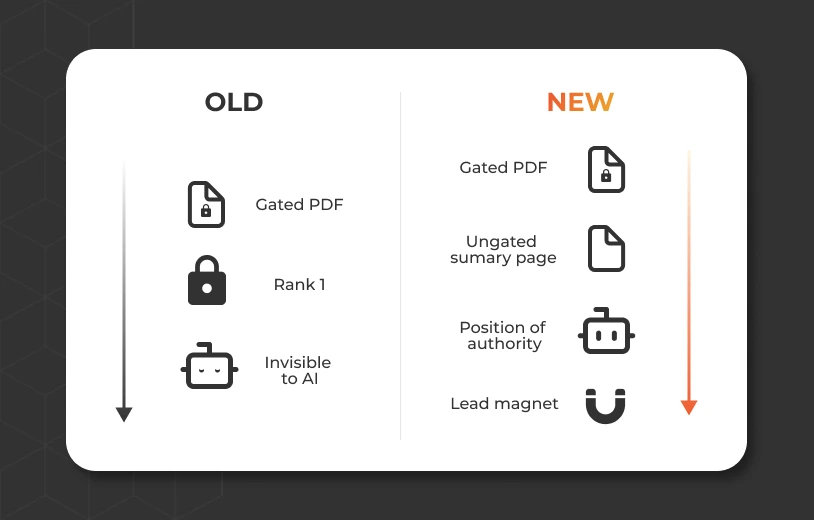
- The "Ungated Summary": Unlock your best content. Take your high-value, gated white papers and publish a comprehensive, 2,000-word "ungated summary" or "Chapter 1." This page feeds the AI, while the full report captures the high-intent lead.
- Become a Primary Source: The most valuable asset is original data. Publish proprietary research, surveys, or industry reports. AI Overviews love to cite statistics, positioning you as the definitive source.
- New KPIs: Stop measuring just "Rank #1." Your new metrics are: Share of Voice in AIOs, Branded Search Uplift, and Lead Quality from your consideration-stage content.
The enterprise buying journey has a new gatekeeper. It’s not a new analyst, a new trade show, or a new industry publication. It’s Google’s AI Overview.
For years, enterprise marketers have perfected a complex dance: create high-value content, get it to rank on the first page of Google, and guide a multi-stakeholder buying committee through a long, nuanced consideration phase.
That entire playbook is being rewritten.
When your prospect—a CTO, a VP of Procurement, or a CISO—asks Google a complex question like, “What are the best enterprise-grade platforms for multi-cloud data governance?” or “ROI analysis of in-house vs. outsourced cybersecurity,” they no longer get a list of 10 blue links.
They get a single, synthesized answer.
If your company’s expertise, data, and value proposition are not the source of that answer, you have become invisible at the most critical moment of the buying journey.
For enterprise SEO, this isn’t just another algorithm update. It’s a fundamental shift from Search Engine Optimization to AI-Answer-Engine Influence. This is the new playbook for winning the complex sale.
The New Reality: How AI Overviews Transform the Enterprise Buying Committee
The enterprise sale isn’t made by one person. It’s made by a committee.
The CFO cares about Total Cost of Ownership (TCO) and Return on Investment (ROI). The CTO cares about integration and technical debt. The end-user VP cares about usability and adoption.
In the past, your marketing team could build separate content funnels to target each of these personas.
- A “Top 10” blog for the initial researcher.
- A technical white paper for the CTO.
- A case study with clear financial metrics for the CFO.
Now, the AI Overview acts as the research assistant for the entire committee. It will pull data from multiple sources to construct a single, comprehensive answer that addresses the technical, financial, and practical questions all at once.
The stakes are simple:
- If you are the source: The AI cites your brand, your data, and your frameworks. You are positioned as the definitive authority before a competitor even gets a click.
- If you are not: You are, at best, a “related link.” At worst, you don’t exist. The 70% of the buyer’s journey that happens before a sales call now happens without you.
Why Enterprises Are Uniquely Positioned to Win (Or Lose)
This new landscape is terrifying for low-effort content farms. For high-authority enterprises, it’s the single greatest opportunity of the decade.
AI models and Google’s E-E-A-T (Expertise, Experience, Authoritativeness, Trustworthiness) guidelines crave exactly what you already have:
- Deep Subject Matter Experts (SMEs): Your engineers, data scientists, and strategists.
- Proprietary Data: Your internal research, customer usage statistics, and market analysis.
- In-Depth Case Studies: Real-world proof of complex problem-solving.
- A Unique Point of View: A documented, authoritative perspective on your industry.
The “threat” is that most enterprises have this critical, AI-fueling content locked away behind lead forms, hidden in PDFs, or trapped in the minds of their SMEs. The new playbook is about strategically unlocking it.
The New Enterprise Playbook: 5 Strategies to Master AI Overviews
Forget “keyword density.” The new goal is to become the most citable source for AI.
1. Pivot from Keywords to "Problem-Solving Ecosystems"
The old model was targeting a single keyword, like “enterprise cloud solutions.”
The new model is to own the entire problem. An enterprise doesn’t just “buy” a solution; it tries to solve a complex, multi-faceted problem. Your content must reflect this.
Instead of one blog post, build an interconnected ecosystem of content that answers every conceivable question about that problem:
- The “What”: What is hybrid cloud data-at-rest encryption?
- The “Why”: Why traditional data security fails in multi-cloud environments.
- The “How”: How to migrate legacy financial data to a secure hybrid cloud.
- The “Who”: Case Study: How [Client Name] reduced compliance risk by 40%.
- The “What if”: Calculating the TCO and ROI of a secure cloud migration.
When AI Overviews scan the web for an answer, they won’t find a single “best” page. They will find your brand demonstrating overwhelming, interconnected authority on the entire topic.
2. Weaponize Your SMEs & "Author-Level" E-E-A-T

AI Overviews need to trust their sources. The easiest way to build that trust is to prove your content is written by real, verifiable experts.
- Actionable Play: Every high-value article must have a named author who is a genuine SME at your company.
- Create Detailed Author Bios: Don’t just list their name. Create a full author profile page (e.g., www.yourcompany.com/experts/jane-doe).
- Link Externally: Link this bio to their LinkedIn profile, any industry conference talks they’ve given, or papers they’ve published.
- Use Schema: Use Author and ProfilePage schema markup to programmatically tell Google, “This article was written by this real person, who is a verified expert in this specific field.”
3. Adopt the "Ungated Summary" Strategy
Your most valuable, in-depth analysis is likely in a 50-page white paper, hidden behind a lead-generation form.
- The problem: Google’s AI can’t read it.
This creates a paradox: your best content is invisible to the new gatekeeper. - Actionable Play: Adopt a “Chapter 1” or “Executive Summary” approach.
Create a comprehensive, 2,000-word “ungated” blog post or webpage that summarizes the key findings, data, and framework of your gated asset.
This page should be a high-value asset on its own, optimized for AI ingestion (clear headings, tables, bullet points).
This page becomes the “citable source” for the AI Overview.
At the end of this page, offer the “full 50-page report with proprietary data” as the content upgrade.
You get the best of both worlds: you feed the AI to win the zero-click, and you capture the high-intent lead who wants to go deeper.
4. Structure Your Content for AI Consumption
AI models prioritize clear structure and scannable formats that make your expertise easy to extract and cite.
Make your content easy for them to understand and cite.
- Use “Scannable” Formats: AI loves lists, tables, and short, declarative sentences. If you’re comparing product features, use a <table>. If you’re outlining a process, use an <ol> (ordered list).
- Hyper-Specific Headings: Your H2s and H3s are your best friends. Don’t use “Our Solution.” Use “How Our Platform Solves [Specific Problem].”
- Implement Robust Schema: Implement Robust Structured Data (Schema.org). Go beyond basic schema implementation. Focus on establishing authority and clarity for both search engines and large language models (LLMs).
- For Authority: Ensure every article links to its author and publisher using Article and Organization or Person schema. For data-driven content, utilize the mainEntityOfPage and about properties within the Article schema to clearly define the article’s subject and main context. This is like handing the AI a well-documented source, not just an index card.
- For Direct Answers: Use FAQPage schema for common questions/answers and HowTo schema for clearly defined, step-by-step processes. These are directly consumable by LLMs for generating snippets and step-by-step instructions.
5. Become a Primary Source with Original Research
In a world of AI-generated summaries, there is one asset that is impossible to commoditize: original data.
AI Overviews love to cite statistics (“According to a study by [Your Company]…”).
- Actionable Play: Commission and publish an annual “State of the Industry” report. Survey your customer base. Analyze your own platform’s usage data (anonymously, of course).
- Publish and Promote: Publish this data on your site in an ungated format (see Strategy #3). This will become the “ground truth” for your entire industry.
- The Result: Every other blogger, journalist, and AI will be forced to cite you when discussing that topic. You don’t just rank; you become the source.
Redefining Success: New KPIs for the AIO Era
Your C-suite will ask how to measure this. The old metric of “Rank #1” is dead. The new game is about influence and authority.
The Enterprise Timeline: A Phased Approach
The shift from classic SEO to AI-Answer-Engine Influence is not a 3-month project; it’s a 6-to-12-month foundational play that delivers compounding, high-quality results.
- Quick Wins (1-3 Months): You’ll see immediate technical improvements, like better indexing and faster visibility for optimized existing content (e.g., ungated summaries). You should also see an initial uplift in your Branded Search Uplift as the AI begins to cite you as a source, driving brand recognition.
- Mid-Term Momentum (4-6 Months): This is when your new, structured content ecosystems and E-E-A-T efforts start to gain traction. You should see a noticeable, sustained increase in your Share of Voice in AIOs and Inbound Links to Data/Research.
- Long-Term Authority (6-12+ Months): This is the window for significant pipeline impact. Consistent authoritative content (like proprietary research) begins to solidify your position as the definitive source in your industry. The ultimate KPI—Lead Quality from Consideration Content—will show that prospects are entering the sales cycle better educated and converting faster. For highly competitive keywords, this timeframe is a necessary investment.
New Enterprise SEO KPIs
You should be setting the following KPIs:
- Share of Voice (SoV) in AIOs: Are you being cited in the AI Overviews for your most critical problem ecosystems?
- (Tools for this are emerging, but manual tracking is essential now).
- Practical Manual Tracking: Track this weekly or monthly by creating a list of your top 20-30 high-intent, complex queries (e.g., “ROI analysis of in-house vs. outsourced cybersecurity”).
- Manually search these queries and note three things:
- Does an AI Overview appear?
- Is your brand cited in the Overview (and where)?
- Which competitor is cited?. This creates a simple SoV percentage and a visual archive of your brand’s presence.
- Branded Search Uplift: As more people see your brand cited, are you seeing an increase in “[Your Brand]” + “[Topic]” searches? This is a powerful buying signal.
- Lead Quality from “Consideration” Content: Are the leads from your “ungated summary” pages more educated and converting to the pipeline faster?
- Inbound Links to Data/Research: Is your original research being cited by other authoritative sites, amplifying your E-E-A-T?
The Final Word: From Ranking to Influencing
AI Overviews are not the end of enterprise SEO. They are the end of lazy SEO. They mark a clear pivot. The game is no longer about tricking an algorithm to get a click.
The game is about providing such overwhelming, authoritative, and well-structured expertise that the AI has no choice but to feature you as the definitive answer.
The Role of Paid Search (PPC) in the AIO Era
While this playbook focuses on building organic authority, Paid Search is more important than ever for controlling the customer journey.
Defense and Acquisition: AI Overviews (AIOs) can push traditional text ads lower on the page, but ads can still appear above, below, or even within the AIO itself, especially for commercial queries. Use PPC to defend your brand terms and aggressively bid on transactional terms that AIOs are less likely to fully resolve.
Citation Amplification: The ultimate synergy is when your brand is both cited organically in the AIO and your paid ad appears on the same page. Data shows that being cited in the AIO can lead to a significantly higher Paid CTR for your associated ads.
Filling the Funnel: As organic traffic shifts to focus on research and problem-solving (top and mid-funnel), use Performance Max and other AI-driven campaign types to diversify reach across YouTube, Display, and Discovery, ensuring comprehensive coverage across the full customer journey.
The enterprises that embrace this shift will build an insurmountable moat.
They won’t just influence search results; they will influence the entire buying journey before a competitor ever knows it began.
Ready to build your AI-proof enterprise SEO and Marketing strategy?
The rules have changed. At Fahrenheit Marketing, we partner with enterprise leaders to build the high-authority content ecosystems and technical SEO foundations that win in this new era.
Schedule your free consultation today to discuss the AI-readiness of your content strategy.