
Outline


Get In Touch
Get In Touch
Key Takeaways
- Third-party cookies are dead. Enterprise brands must transition from reliance on cross-site tracking to first-party data strategies.
- First-party data is the new gold. Collect data directly from customers with consent, building trust and owning your insights.
- CDPs are essential. Unify and activate your first-party data effectively with a Customer Data Platform.
- Innovate measurement. Shift to probabilistic models, Marketing Mix Modeling, and privacy-enhancing technologies like Data Clean Rooms.
- Ethics and compliance are foundational. Integrate privacy into marketing by design, not as an afterthought.
- SEO and content are inherently privacy-friendly. Build organic presence and capture direct customer intent.
- Proactive adaptation is a competitive advantage. Brands that act now will lead the market.
The digital marketing landscape is undergoing a profound evolution, moving toward a new era of privacy-centric customer relationships. While the foundation built on third-party cookies is being retired, this transition presents enterprise brands with an urgent, yet strategic, opportunity to build more sustainable and direct growth channels.
The historical reliance on this legacy data layer has been substantial: studies indicate that nearly 83% of marketers have historically depended on third-party cookie data to inform their campaigns. The immediate, critical task is to effectively replace this foundational data source.
This change is more than a simple adjustment; it represents a significant strategic recalibration. The traditional methods of understanding customer journeys, personalizing experiences, and attributing conversions are being fundamentally reshaped by three powerful forces:
- The Demise of Third-Party Cookies: Google’s phased deprecation of third-party cookies in Chrome, following similar moves by browsers like Safari (ITP) and Firefox (ETP), eliminates the primary mechanism for cross-site tracking and retargeting.
- Escalating Global Regulations: Laws like the GDPR in Europe and the CCPA/CPRA in California have set a new standard for data protection, empowering consumers with greater control over their personal information and imposing significant penalties for non-compliance.
- Consumer Demand for Privacy: Beyond regulations, consumers themselves are increasingly aware and concerned about how their data is used. Trust, transparency, and respect for privacy in marketing are no longer just good practice – they are table stakes.
The loss of cookies is considered a more impactful challenge than even major global regulations, with 69% of US marketers stating its impact will be greater than both GDPR and CCPA combined.
For enterprise marketers, the core problem is clear: how do you maintain effective targeting, deliver personalized experiences, measure campaign performance, and prove ROI when your traditional data streams are drying up?
The answer lies in proactive strategy, technological innovation, and a renewed focus on direct customer relationships.
The Strategic Solution: Shifting to a First-Party Data Fortress

The future of effective marketing in the post-cookie era hinges on one critical asset: first-party data. This is the information you collect directly from your customers with their explicit consent and in exchange for value.
It’s data you own, control, and can leverage without reliance on external identifiers or intermediaries. The imperative to build a robust first-party data strategy is about more than just compliance; it’s about building a deeper, more resilient relationship with your customers.
Trust becomes the new currency, and ethical data collection practices are your most valuable investment.
To construct this first-party data fortress, enterprise brands must:
Audit & Consolidate Your Data Strategy:
Begin with a comprehensive audit of all your existing data touchpoints. Where do you currently collect customer data? This includes your CRM, website analytics, email marketing platforms, loyalty programs, customer service interactions, and even offline sales data.
The goal is to identify, consolidate, and unify these disparate sources. A Customer Data Platform (CDP) is no longer a luxury but a critical tool for enterprises, allowing you to create a single, unified view of each customer and activate that data across all channels.
Cultivate Content as a Data Collection Engine:
In the new landscape, content isn’t just for engagement; it’s a strategic tool for ethical data acquisition. High-value content – think exclusive white papers, interactive tools, personalized assessments, webinars, or members-only resources – can encourage voluntary data sharing. When you offer genuine value in exchange for information, you build trust and ensure compliance with privacy in marketing principles by focusing on explicit consent.
Innovating Measurement and Activation
With the traditional methods of tracking and attribution diminishing, enterprise brands must innovate in how they measure impact and activate campaigns.
This requires a shift from individual-level, deterministic tracking to more aggregated, privacy-preserving approaches.
The reward for successful adaptation is substantial: companies delivering privacy-safe, personalized experiences can see cost savings of up to 30% and revenue increases of up to 20%.
The Rise of Alternative Identity Solutions
Contextual Targeting’s Resurgence:
Old is new again. Targeting based on the content of a webpage, rather than a user’s browsing history, is inherently privacy-safe and proving to be highly effective when executed intelligently.
Authenticated Identity:
Solutions like Unified ID 2.0 (UID2) offer a privacy-conscious alternative. They use anonymized and encrypted email addresses (with user consent) to create a persistent, cross-site identifier, enabling personalized advertising while respecting user privacy in marketing.
Privacy-Enhancing Technologies (PETs): The Enterprise Toolkit

Data Clean Rooms (DCRs):
These are pivotal for enterprise collaboration. DCRs allow multiple parties (e.g., brands and publishers) to securely combine and analyze their first-party data without ever sharing raw, identifiable customer information.
This enables powerful insights, shared audience targeting, and campaign measurement in a privacy-compliant environment.
Federated Learning & Differential Privacy:
These advanced cryptographic techniques enable collective insights from decentralized datasets without exposing individual data points.
While complex, they represent the cutting edge of privacy-preserving analytics for large organizations.
Attribution and Modeling Reinvented
Beyond the Click:
The era of last-click attribution is definitely over. Marketers must move towards probabilistic measurement, relying on aggregated data, statistical modeling, and incrementality testing rather than direct, user-level tracking.
Marketing Mix Modeling (MMM):
This tried-and-true method is regaining prominence. MMM analyzes historical sales and marketing spend data to determine the contribution of different channels and activities to overall business outcomes, offering a high-level view of ROI when granular tracking is unavailable.
The Fahrenheit Framework: Building a Future-Ready Enterprise
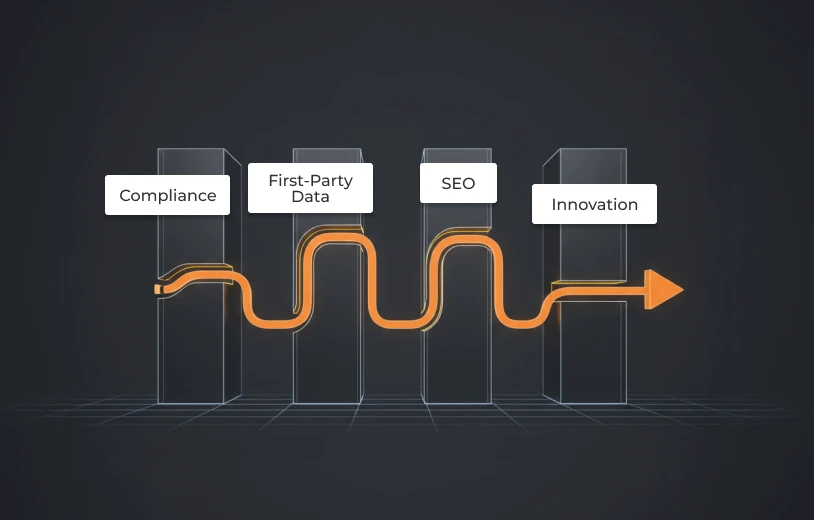
Navigating this complex landscape requires more than just adopting new tools; it demands a strategic partner who understands the nuances of enterprise marketing and the critical role of privacy in marketing.
Fahrenheit Marketing offers a comprehensive framework to future-proof your brand:
Operationalizing Compliance and Ethics
Effective data governance is paramount. We help you establish clear internal policies, conduct regular audits, and provide continuous training for your marketing teams to ensure every campaign adheres to the highest standards of data privacy and ethical conduct.
We integrate compliance by design, making it an intrinsic part of your strategy, not an afterthought.
The SEO and Content Nexus
A strong, organic presence is inherently privacy-friendly. Robust SEO (technical optimization, authoritative content, and exceptional user experience) reduces reliance on paid channels that depend on third-party tracking.
We help you develop a content strategy that captures high-intent users directly, building your first-party data assets from the ground up.
Strategic Partnerships and Ecosystem Integration
The post-cookie world is collaborative. We guide you in identifying and integrating with the right partners—from CDPs and DCR providers to identity solution vendors—to build a resilient and effective marketing technology stack tailored to your enterprise needs.
Your Next Step
The post-cookie era presents both challenges and unparalleled opportunities.
Brands that proactively embrace this transformation, prioritize consumer privacy in marketing, and strategically invest in their first-party data infrastructure will not just survive—they will thrive and dominate the next decade.
Are you ready to transform your marketing strategy from reactive to resilient?
Schedule your free consultation today to future-proof your measurement and activation models for sustainable growth.